Promoting skilled workers, enabling innovation
Machine tool manufacturing is an important pillar of industrial value creation – and its future depends more than ever on two factors: well-trained skilled workers and continuous technological development. Against this backdrop, the education and science sector plays a key role. Modern manufacturing technologies are part of everyday life in training workshops and educational and research institutions. In this way, they also contribute to promoting young talent and driving innovation. This presents machine tool manufacturers with a wide range of opportunities – but also a responsibility.
Rethinking training: Machine tools as a sustainable learning platform

The requirements for trainees in technical professions have changed significantly in recent years. In addition to manual skills, digital competencies, systemic thinking, and process understanding are now in demand. Traditional training on conventional machines and entry-level CNC machines alone is no longer sufficient. Instead, didactically well-designed, technologically advanced solutions are needed. This applies in particular to machine tools and their digital twins for simulation and classroom programming.
Vocational schools, training centers, and universities increasingly view CNC machines as learning platforms that go far beyond simple milling, turning, or drilling. They make it possible to simulate real manufacturing processes, write NC programs, analyze machine data, and understand entire production processes. Particularly important: they are often operated using modern controls with intuitive interfaces that make them easy to use even for beginners, while also leaving room for advanced applications.
Such technologies create a smooth transition between training and industry. Learners work on the same machines that will later be used in production. This promotes practical skills, shortens training periods, and increases the employability of young people. At the same time, training companies benefit: they can prepare their employees more specifically for the requirements of their industry and secure qualified personnel in the long term. The attractiveness of training also increases—because young people want to work with products that reflect the state of the art.
Research as a driver of innovation: precision and flexibility in the scientific environment
In addition to training, the scientific sector is another important driver for the use of machine tools. Universities, technical colleges, and non-university research institutions use advanced CNC technologies for a wide range of demanding tasks: from the development of new materials and prototyping to the testing of new manufacturing processes.
Special requirements apply here: machines must not only work with high precision, but also be flexible and adaptable. Research projects are rarely standardized—instead, they require open control systems, expandable interfaces, and the ability to integrate into complex experimental setups. Digital twins, real-time sensory monitoring, and AI-supported process optimization are no longer visions, but have long been part of everyday scientific life.
In this environment, the machine tool becomes a tool for knowledge—it not only helps to build components, but also provides data, insights, and experimental foundations for new technologies. In interdisciplinary projects, such as in aerospace, medical technology, or electromobility, it is often the link between theoretical concept and practical implementation.
Exploiting synergies between industry, education, and research
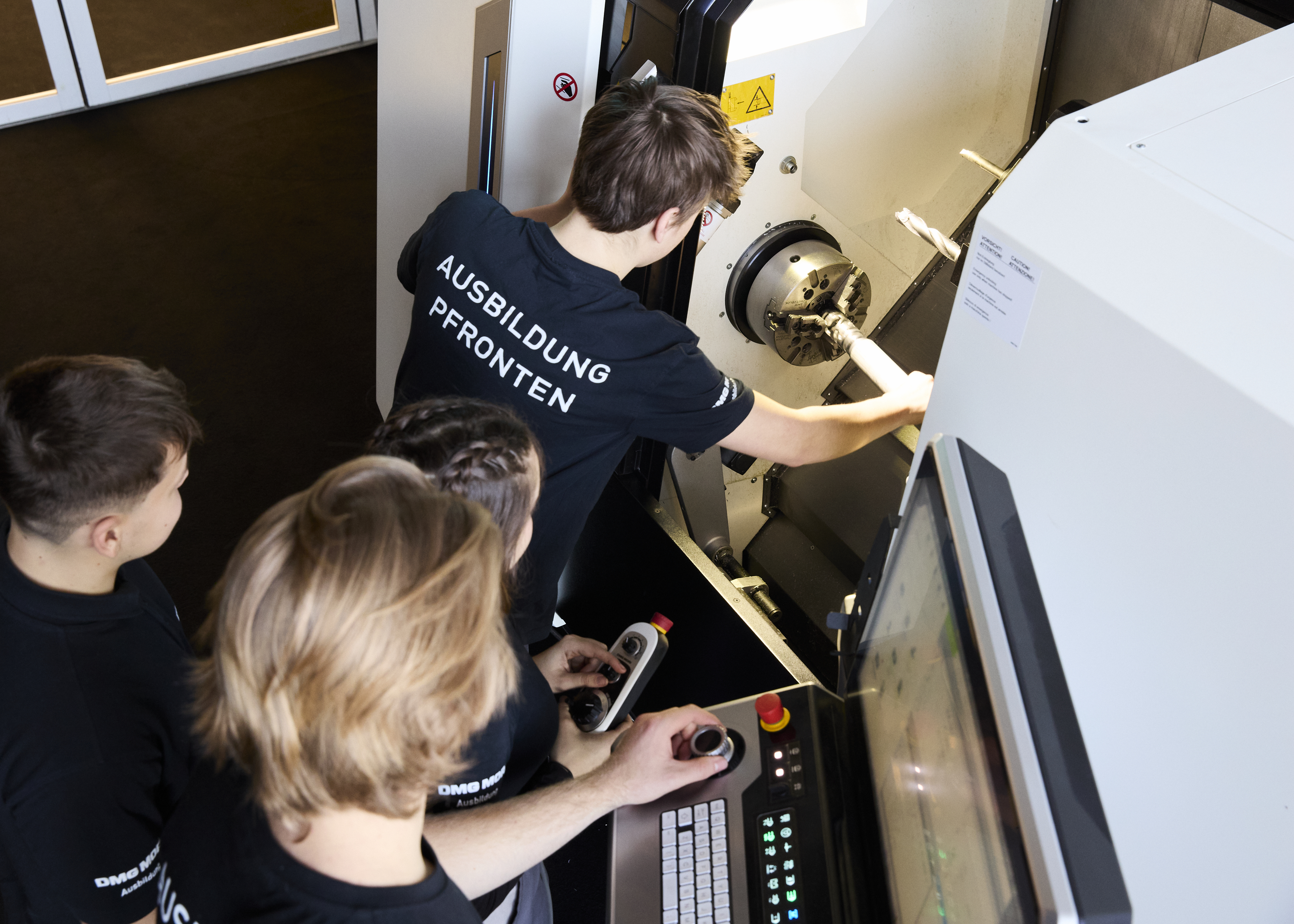
Close cooperation between companies, educational institutions, and science offers enormous potential. Training partnerships, dual study programs, and research networks make it possible to introduce young talent to modern technologies at an early stage and quickly translate innovations into industrial applications. This is precisely where the DMG MORI Academy comes in—for example, by providing tailor-made packages for training companies, through cooperation with universities, or through digital learning platforms that facilitate the understanding of complex manufacturing processes. DMG MORI sees such cooperation as another opportunity to help shape the future of machine tool manufacturing—both in technological and social terms. Its commitment to education and science is thus proving to be a strategic building block for sustainable corporate success.
Education & Science as the future market for machine tool manufacturing

A look at the education and science sector shows that this industry is much more than a niche market. It is a field of the future with great strategic importance. Machine tools used in training centers and research laboratories are investments in minds, ideas, and competitiveness. Ultimately, those who inspire young people to take an interest in technology and support research with powerful tools are not only shaping their own future, but that of the entire industry.